Renewal of Haarlem Waarderpolder: from wastewater treatment plant to energy factory
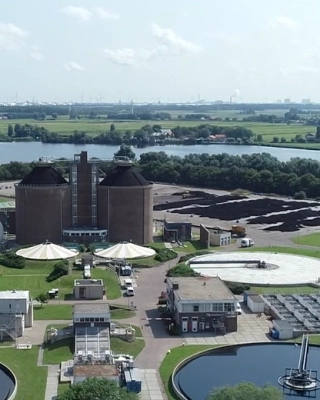
From the end of this year until 2031, the Haarlem Waarderpolder Wastewater Treatment Plant (WWTP) is set to undergo a large-scale renovation and expansion. In addition to its primary function of treating wastewater from the region, the facility will also serve as an energy factory, playing a key role in driving regional sustainability. Iv is closely involved in the development of the central sludge fermentation facility. This is one of the largest and most complex projects within the Rijnland District Water Control Board.
The Haarlem region is growing. As the number of residents and businesses increases, so does the pressure on the existing wastewater infrastructure. The Haarlem Waarderpolder WWTP dates back to the 1960s and is one of the largest treatment plants operated by the Rijnland District Water Control Board. Originally designed to serve a population of 224,000, it currently treats wastewater for around 250,000 people from multiple municipalities.
To meet the new water quality standards and accommodate regional growth, plans are in place for a large-scale renovation and expansion. In May, the Rijnland District Water Control Board approved the renovation implementation budget. This decision marks a significant step towards realising a new facility that will both increase capacity and enhance the sustainability of the treatment process. Once the project is completed, the plant’s processing capacity will increase from 8,700 m³ per hour to 9,000 m³ per hour.
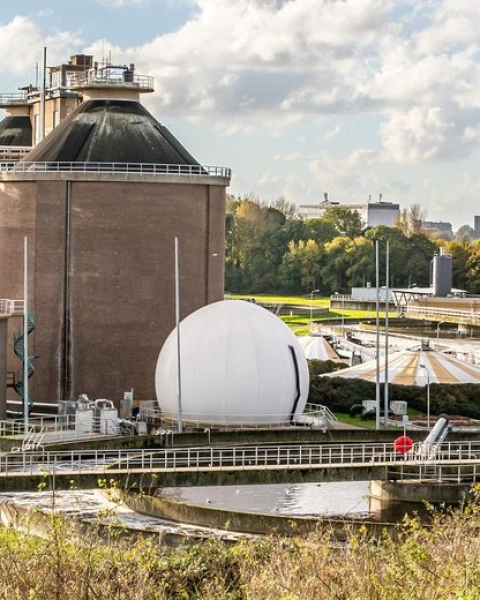
A key element of this project is the expansion of the sludge line to create a central sludge fermentation facility. Sewage sludge is a residual product of the wastewater treatment process. Fermenting this sludge at approximately 35°C reduces its volume and converts it into biogas, a renewable energy source. Haarlem Waarderpolder is currently one of four WWTPs of the district water control board where sludge is fermented on-site. While in the current situation, primarily self-produced sludge is fermented, the new centralised fermentation facility will process sludge from as many as thirteen WWTPs. Sludge from the Zwanenburg WWTP and the Schalkwijk pumping station will be transported via a pressurised pipeline, while HGV will deliver sludge from the other treatment plants.
A new sludge treatment building is to be constructed for this purpose. Sludge delivered by HGV will be unloaded in enclosed halls to prevent odour emissions. Inside the building, the different sludge streams will be blended and screened for contaminants. The sludge will then be thickened using thickening centrifuges to reach the desired dry solids content. It will subsequently be pumped into adjacent fermentation tanks equipped with Ephyra® technology from Haskoning. During fermentation, the volume of sludge is reduced through biological degradation. The fermented sludge is then dewatered using centrifuges to further minimise the final volume to be transported by HGV to the incineration facility. To ensure operational continuity, buffer tanks will be installed in the building to store both externally delivered sludge and dewatered sludge.
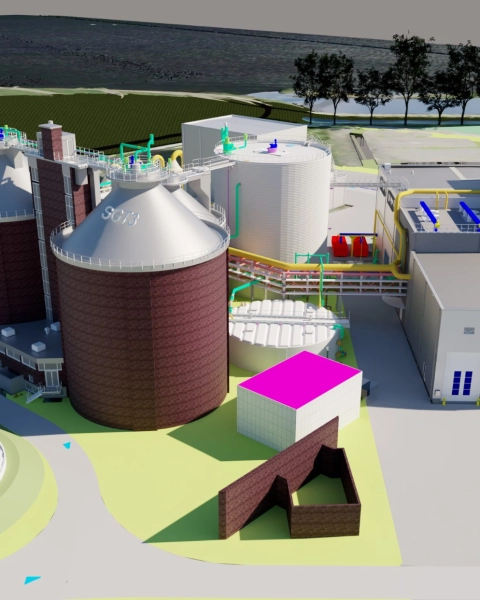
The biogas produced through fermentation will be upgraded to green gas. Once processed, this gas is of the same quality as natural gas but is not derived from fossil fuels, making it a sustainable energy source. The CO₂ released during the upgrading process will be captured and converted into liquid CO₂ for use in industrial applications and transported off-site by HGV. The required green gas installation will be built on the WWTP site.
Most of the green gas produced will be fed into the natural gas grid in Haarlem. A smaller portion of the biogas will be used locally to generate heat and electricity. For heating the sludge, the system will primarily rely on thermal energy recovered from wastewater (TEA). Through a heat pump installation, heat will be extracted from the effluent (treated wastewater), which will significantly reduce the need to use biogas for sludge heating.
In terms of scale and complexity, this project is quite unique. For this reason, Rijnland has chosen to involve all engineering companies from its framework agreement for consultancy services in the design phase. Iv and Arcadis are focusing on the sludge line, energy systems and site layout. Haskoning and Witteveen+Bos are responsible for the water line, while Aveco de Bondt is handling the Environmental Impact Assessment and the operations building. Together, these parties have developed an integral process design and preliminary design for the new facility. The final design phase is being carried out in a building team format. The sludge line team has been expanded with the contractor consortium ‘Zuiver èn HWP’, comprising ADS Groep and Dura Vermeer. Besix has joined as a construction partner for the water line.
Thanks to this broad collaboration, all necessary expertise is available within the project team. However, this approach also presents organisational challenges. One example is the technological design. To maintain project manageability, several sub-projects have been defined. The key challenge is to ensure coherence among these sub-projects. Although the work is divided into parts, the final facility must function as a single integral system. To achieve this, a team of technologists from various organisations has developed a comprehensive process design to ensure that all components align seamlessly. Managing the many internal and external interfaces also requires an integral approach. To support this, Model-Based Systems Engineering (MBSE) is being used for visualisation. This method provides a clear visual representation of the overall design and the interactions between systems and processes, which contributes to better coordination and risk management throughout the project.
Iv is currently working on the final design of the sludge and gas line, incorporating the disciplines of process technology, civil and structural engineering, mechanical engineering, electrical engineering, and process automation. Challenges include coordinating the interfaces of other sub-projects and the existing underground infrastructure. The entire facility is being modelled in 3D. Combining all parts into a single integral model for the entire WWTP secures the interfaces between system components and identifies potential conflicts with underground infrastructure or construction phasing.
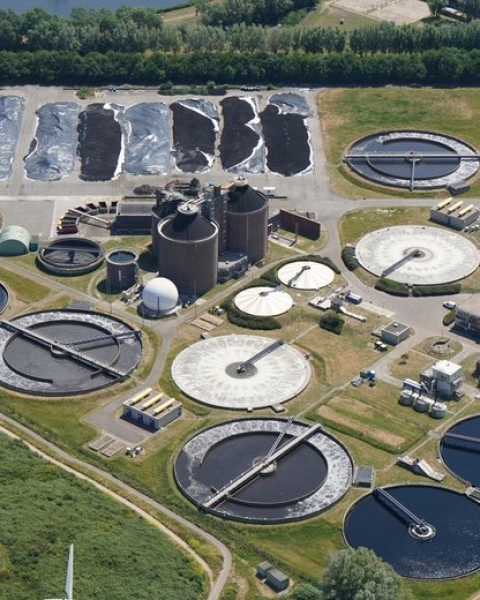
Construction will take place on a fully operational site, meaning that the WWTP will continue to function throughout the construction. Space on the site is limited, which requires careful phased planning. The project must take into account the underground infrastructure, delivery times for materials and equipment, construction traffic, sludge transport, environmental compensation, minimising disruption to the surrounding area, and timely reinforcement of energy consumption. Given the current challenges with grid congestion, this is also a key consideration.
The approval of the implementation budget in May has paved the way for the project’s realisation phase. Construction is scheduled to begin at the end of 2025 and is expected to be fully completed by 2031.
Paul, managing director Water, would be delighted to discuss this with you! Get in touch via +31 88 943 3900 or send a message.