Compression station
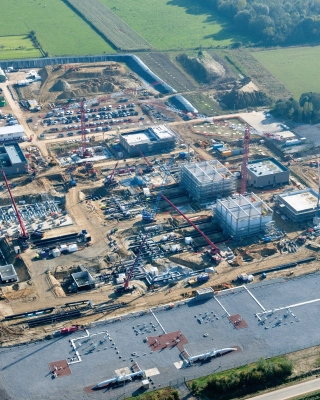
The compression station in Winksele forms part of Fluxys’ Belgian gas transmission network, a key hub for international gas flows across Europe. The network, comprising approximately 4,000 kilometres of pipelines, is strongly interconnected with neighbouring countries. To accommodate additional gas flows and increase operational flexibility, a second compression station was constructed alongside the existing installation. This new station can operate independently and significantly increases transport capacity within the network.
The project was executed by Joint Venture Winksele (Iv and Visser & Smit Hanab) under an EPC contract. Within this collaboration, Iv was responsible for the complete design and engineering of the compression station, as well as the procurement of all equipment. This included, among other things, the selection and specification of installations, electrical systems, instrumentation and automation systems, including inspections, expediting and support during testing and commissioning. Visser & Smit Hanab was responsible for the mechanical construction scope. Other EPC activities, such as project management and commissioning, were carried out collectively within the joint venture.
The station consists of multiple compressors, each with a capacity of 18 megawatts, providing a total compression capacity of approximately 3,500,000 Nm³/h. In this way, the installation brings the gas to the required pressure for long-distance transmission, supporting both the supply of energy in Belgium and cross-border gas flows within Northwest Europe.
The main challenge lay in designing and integrating a new compression station alongside an existing installation, while maintaining continuity of gas transmission operations.
Processing large volumes of high pressure gas places significant demands on the reliability, safety and availability of the installation. Due to the station’s role within international gas flows, a significantly high level of availability was required, as compressor outages would have a direct impact on the network’s transport capacity. This led to a design with strict requirements for redundancy, system integration and the selection of critical equipment, such as compressors and supporting installations.
Additionally, the scale of the station, with its extensive piping systems, installations and multidisciplinary interfaces, called for integrated design approach. Mechanical, electrical and automation systems had to be seamlessly coordinated. This demanded close collaboration between engineering and procurement, ensuring that technical decisions and equipment availability were aligned throughout the project.
The project increases both the transport capacity and flexibility of the Fluxys gas transmission network. This network plays a central role in the exchange of gas between countries in Northwest Europe and contributes to a stable and reliable energy supply.
The role of this type of infrastructure within the energy transition is nuanced. Although the project focuses on gas transmission, it forms part of an energy system that is continually evolving. The transition from low-calorific to high-calorific gas is one example of this development. At the same time, this type of infrastructure is regarded by transmission system operators as a potential basis for the transport of energy carriers such as hydrogen and CO₂. As such, the station may also fulfil a role within a broader and future-proof energy system.
Fedor, managing director of Offshore & Energy, would be delighted to discuss this with you! Get in touch via +31 88 943 3300 or send a message.