From concept to commissioning: engineering of OSS Jasmund
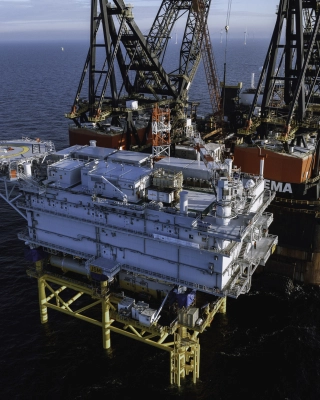
With the recent installation of the Jasmund offshore substation (OSS) in the Baltic Sea, grid operator 50Hertz has taken a significant step forward in the Ostwind 3 project. Soon, the substation will provide the link between energy generated at the wind farm and the onshore electricity grid. Behind the platform lies an intensive process of engineering, combining integration, standardisation, and flexibility. In conversation with Rob van Hood, Iv Project Manager, we delve deeper into the project’s engineering and technical challenges.
Jasmund is located northeast of the island of Rügen, approximately 100 kilometres off the coast from the German city of Lubmin. The OSS is part of the Windanker offshore wind farm. Once operational, it will convert energy generated at the wind farm for transport to shore. With a capacity of 315 megawatts, it will supply green electricity to approximately 260,000 households. The realisation of the OSS has been entrusted to the HSI consortium (comprising Smulders HSM and Iv), responsible for the total scope of work: engineering, procurement, construction, transport, installation, and commissioning (EPCIC). Within this context, Iv’s responsibility is the integrated design of the OSS, as well as procurement of the auxiliary systems. What, specifically, does this entail? Rob explains, “We do not design individual components, but essentially a complete system. We do this in close collaboration with Smulders HSM. As a system integrator, we integrate between 40 and 45 subsystems, ranging from safety and emergency power supplies to communication and control systems, into the overall design, ensuring that they work together seamlessly. We maintain close contact with suppliers of components and subsystems. This is of particular importance when changes occur, as even minor adaptations can have an impact on the overall design.”
To ensure the realisation of a well-performing, reliable system, Iv is involved in all phases of the project: from initial concept design, through realisation and final delivery. Rob: “Even in the early design phase, we provide support in strategic decision-making, such as the location of the OSS. The choice of this has a direct impact on the total design, from foundation to topside, as well as the method used for transport and installation. We also define the tolerance requirements that determine offshore installation.”
Being involved early in the project enables transport, lifting operations and offshore installation to be directly incorporated into the design, reducing risks later on.
Iv remains involved throughout the process. “Our engineering team continually coordinates between different disciplines, suppliers, and partners, and monitors the coherence within the project. With a specialised team, we work not only on the engineering, but also on the procurement of systems and components. Additionally, we provide technical support during fabrication. This combination ensures seamless alignment of design and execution.”
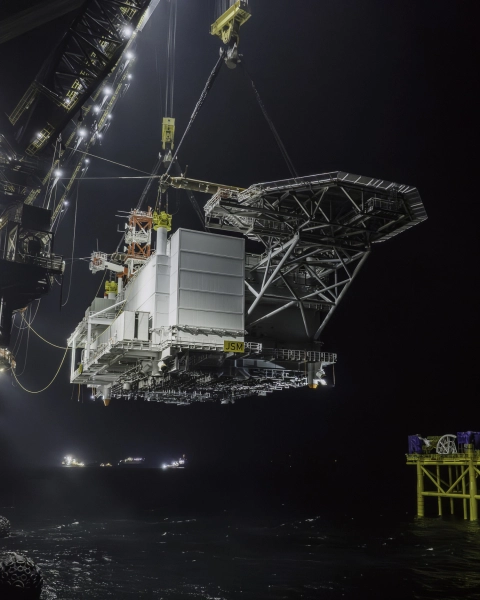
The engineering of the Jasmund OSS was complex. Jasmund is the first in a series of three OSS based on a standardised HVAC design that Iv has developed for 50Hertz. Besides Jasmund, the series includes Zingst and Darß, which are being realised at other locations in the Baltic Sea. Standardisation offers clear advantages, though unique conditions and requirements mean that offshore projects can never be completely standard.
While being intended for use at three different locations, the design Iv developed for 50Hertz retains room for project-specific adjustments. During the project, the design was optimised a number of times, without disruption to the schedule. “Within a short space of time, the design changed to the extent it was effectively a new substation,” explains Rob. “The result of these optimisations is a significantly lighter substation, while maintaining the same capacity. This increases efficiency, but it does require a considerable amount of flexibility and collaboration within the team.”
To achieve this, compact design was key. Through design solutions, it was possible to reduce the weight of the structure without compromising on performance or reliability.
For the Jasmund offshore substation, a skirt-pile jacket was chosen. This is a different solution than those used at Zingst and Darß. What is the reason for this choice? Rob explains: “We conducted approximately 30 concept studies. These led to the choice of the skirt-pile jacket. Foundation types are always determined by site-specific conditions. Standard solutions simply do not exist offshore. The decisive factor in this case was the water depth. Jasmund is located at a site with a water depth of approximately 43 metres. This is much deeper than the 17-metre depth at the locations where Zingst and Darß will soon be constructed.”
The Jasmund OSS has now been installed offshore, but Iv’s work does not end here. Immediately after departing the shipyard, a new and critical phase of the project begins. During offshore installation, external factors such as weather and sea conditions play a major role. “Offshore conditions are difficult to predict. Therefore, close coordination with partners and the client is crucial in this phase,” Rob explains.
At the time of writing, the project is in the offshore hook-up and commissioning phase. During this phase, all systems are electrically connected, integrated, and tested following power-up. It is a process in which precision and coordination are essential. In this, the consortium’s offshore team is supported by the client and by Iv engineers, who provide both technical expertise and implementation support. “We coordinate suppliers, monitor interfaces, and ensure that all subsystems function as a single unit. In this phase, the importance of integrated engineering becomes clearly apparent,” says Rob.
Going forward, the focus will be on integrating and testing all systems so that the substation can be delivered fully operational and the wind farm can be connected to the grid safely and reliably.
Fedor, managing director Offshore & Energy and also COO of Iv, would be delighted to discuss this with you! Get in touch via +31 88 943 3300 or send a message.