Installation environment for a waste post-separation facility
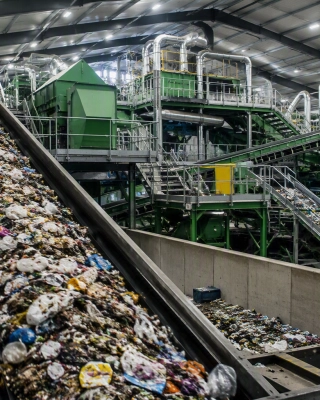
A post-separation facility has been developed for the treatment of residual household waste. The facility processes mixed waste and separates it into several high-value material streams, including plastics and metals. Organic residual fractions can also be utilised for energy generation.
Within this project, Iv was responsible for the design of the entire installation environment, including the building, technical rooms, building services, and the associated infrastructure, such as roads, drainage and site layout.
The large dimensions of the processing hall made the structural design particularly challenging. The hall was designed around a post-separation system whose final design had not yet been established at the start of the project. As a result, it was not possible to incorporate stability elements within the centre of the hall, requiring a large clear-span structure with no internal supports.
Owing to the hall’s length, height and open configuration, wind loading played a significant role in the structural design. Wind loads acting on the longitudinal façades are transferred to the end walls and truss frames. This was achieved through a combination of roof and wall bracing, together with partially moment-resisting connections between the truss columns and truss beams.
The truss columns not only provide sufficient stiffness over the full height of the structure but also accommodate access platforms for inspection and maintenance. To avoid high tensile forces in the foundations, each truss column terminates at its base on a single base plate.
By delivering a well-considered design for the complete installation environment, Iv provided a robust foundation for the efficient operation of the post-separation facility. High-quality post-separation enables valuable raw materials to be recovered and returned to the production chain, reducing the volume of residual waste requiring incineration. In addition, organic residual fractions can be used to generate sustainable energy.
Facilities such as these play an important role in the transition to a circular economy. They support more efficient use of raw materials, reduce dependence on primary resources, and help minimise the environmental impact of waste treatment.
Ralf, managing director Industry, would be delighted to discuss this with you! Get in touch via +31 88 943 3700 or send a message.