Turning industrial emissions into valuable resources: Innovative CO₂ capture installation
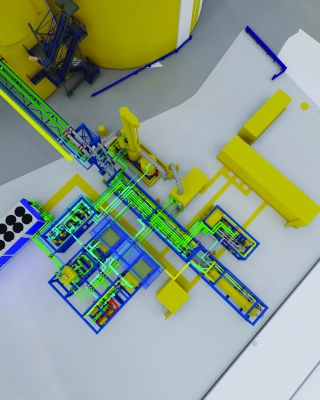
An installation that extracts CO₂ from factory flue gases and converts it into a usable raw material. Affordable, circular, and with a significant impact – exactly what the industrial sector needs to truly meet its climate targets. Commissioned by the British start-up Cool Planet Technologies (CPT), Iv is responsible for the detailed engineering of this advanced, membrane-based installation that captures and refines large volumes of CO₂ to a high CO₂ purity level, making it ready for commercial reuse. The installation is a significant scale-up from preceding pilot installations and is the next step towards realising the ambition to go much further: scaling up to industrial application on a global scale. The system is significantly more cost-effective than existing installations and can be deployed at any plant with so-called point-source emissions.
The project is being carried out at a cement factory in Germany. Cement is indispensable to the construction industry, but its production comes with a significant drawback: heating limestone (calcium carbonate) releases vast amounts of CO₂. This process alone is responsible for nearly 8% of global emissions, considerably more than the entire aviation sector combined.
A substantial share of global CO₂ emissions are released through industrial point sources, such as factory chimneys. These are precisely the areas where targeted capture can make a difference. That is the focus of this installation: with a projected capacity of 10,000 tonnes of CO₂ per year, the compact installation is designed to demonstrate the feasibility of high-quality capture within limited space and power consumption. This is no small feat. This amount of CO₂ is equivalent to the annual absorption of around 500,000 trees or the emissions from approximately 5,000 return flights between Amsterdam and New York.
In collaboration with the German research institute Helmholtz Hereon, CPT is commercialising an innovative membrane technology for CO₂ capture. Unlike traditional CO₂ capture methods, such as chemical absorption, this technology operates through a continuous physical separation process. The result? A stable process with up to 50% lower operational costs compared to existing methods and a CO₂ stream with 99% purity. And that purity is key: the cleaner the captured CO₂, the broader its potential for reuse. Applications include the production of sustainable aviation fuel, use in the food industry, or CO₂ as a raw material in the chemical industry, for example, in fertilisers or plastics. The purer the gas, the more versatile and valuable its applications.
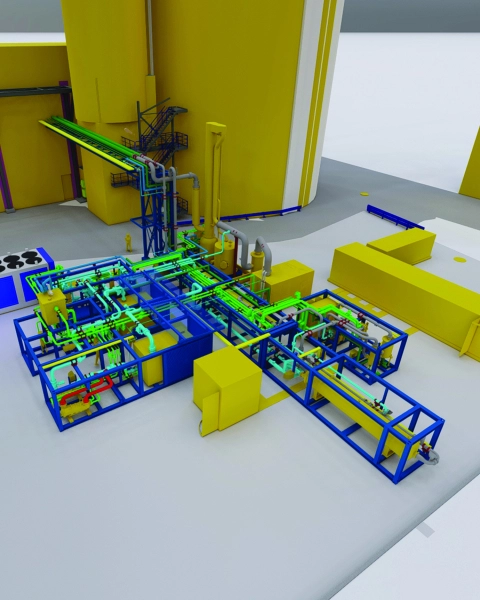
But how does the capture process work? It begins with the flue gases, which undergo several steps to ensure cleaner emissions. First, the gas is cooled and stripped of dust and other solid particles in a scrubber. Then, the core of the process follows: the gas passes through two membrane stages. In the first stage, CO₂ is separated from the flue gas; in the second stage, it is further purified to produce a high-concentration CO₂ stream, which can then be further purified for transport, storage or use.
Unlike conventional technologies, which often struggle with high nitrogen residues and complex maintenance, this membrane-based system is modular in design, easier to scale, and less maintenance-intensive. The installation in Germany is, therefore, much more than just a test setup: it is a crucial step towards large-scale industrial deployment. With a planned one-year testing period, the aim is to demonstrate that the membrane technology can deliver long-term reliability and efficiency. Thanks to the high quality of the recovered CO₂, the expected lower maintenance requirements, reduced energy consumption, and a promising pathway to circular applications, this technology is poised to be a game-changer in the fight against CO₂ emissions.
Iv is responsible for the complete design and project management of the installation. The entire system is being built as a skid-mounted unit, meaning it is modular, containerised, and relocatable to other facilities, demonstrating its potential. This approach places high demands on the engineering: piping, equipment, and connections must be integrated with millimetre precision. Everything must fit within the confines of standard shipping containers without compromising on functionality or safety.
The installation is being integrated into an existing factory site. To make this possible, Iv used a 3D laser scanner to scan the designated area. Based on this model, Iv is carrying out the detailed engineering, including tie-ins with the factory, stress analyses, isometric drawings, and connection layouts.
“This project is moving incredibly fast,” says Dirk, project engineer at Iv. “We began the detailed design process in January 2025, completing 90% of the model review by May. Thanks to a strong partnership with our client, the collaboration between CPT and Iv is seamless and highly productive. CPT’s specialised expertise in membranes and Iv’s advanced engineering capabilities enable us to deliver outstanding results that drive innovation and success.”
Although it is still small in scale, the installation already shows significant potential. For many industrial point sources, one or two such units could deliver substantial CO₂ reductions. While the current setup captures 10,000 tonnes annually, the next step is clear: a full-scale industrial facility with a capture capacity of one million tonnes per annum.
“Iv performed the initial FEED for the project, and we are very pleased to be continuing the relationship into the detailed engineering and procurement stage for what is a critical project for CPT. The CPT and Iv teams are working collaboratively, an approach we would very much like to adopt in future projects. CPT is already working on much larger projects as we scale up the deployment of our technology.” – Andrew Corner, managing director of CPT
Ralf, managing director Industry, would be delighted to discuss this with you! Get in touch via +31 88 943 3700 or send a message.