Iv provides Rijkswaterstaat with crucial failure probability expertise for storm surge barriers
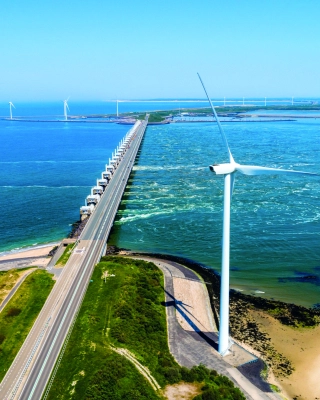
Storm Ciarán tracked across the Netherlands on Thursday 2 November 2023. Causing one death, several injuries and at least 15 million euros in damage in the Netherlands. It was the reason for the first storm surge barrier closure in the ’23/’24 storm season of the oldest structure of the Delta Works: the Hollandse IJssel storm surge barrier. On 24 November, it happened again. As a precaution, the Directorate-General for Public Works and Water Management (Rijkswaterstaat) closed the Hollandse IJssel storm surge barrier and the Haringvliet locks. Due to high water, the Ramspol inflatable surge barrier near Kampen was automatically closed the same morning.
The Netherlands has six movable storm surge barriers managed by the Directorate-General for Public Works and Water Management. In addition to the three barriers mentioned above are the Zeeland Eastern Scheldt storm surge barrier, the Hartel barrier near Spijkenisse and the Maeslant barrier near Hoek van Holland. To protect the hinterland from flooding, the barriers must be closed in good time during heavy storms and remain closed during periods of high water. From a navigation and/or water management perspective, barriers must reopen again when storms have passed.
Arno Willems, director of asset management at Iv and an active RAMS consultant for storm surge barriers for decades, says: “Of course, there are no 100% guarantees. However, we can ensure that the probability of the barriers not closing, not remaining closed or not opening in response to a closure request is sufficiently low to provide the hinterland with sufficient flood protection without unnecessarily compromising the primary functions of the closable water systems for too long. This is what we call the failure probability of the barriers. A logical question is, of course, when are the failure probabilities sufficiently low? Based on an integral risk approach, maximum failure probabilities have been derived for all our primary flood defence structures and defined as a standard in the Water Act. This also applies to the six movable storm surge barriers.
| Storm flood barrier | Probability of failure or exceedance | Water Act standard |
|---|---|---|
| Maeslant barrier | Probability of failure when closing | 1:100 |
| Hartel barrier | Probability of failure when closing | 1:10 |
| Hollandsche IJssel barrier | Probability of failure when closing | 1:200 |
| Ramspol barrier | Probability of failure when closing | 1:100 |
| Eastern Scheldt barrier | Protection level in years | 1:10.000 |
| Haringvliet locks | Protection level in years | 1:1.000 |
To ensure compliance with these safety standards, failure probabilities are recalculated and reported at least twice a year in order to verify regulatory compliance: Once just before the start of the storm season (1 October) and once after the end of the storm season (1 April according to the Water Act, although some operators use 15 April). For this purpose, various failure probability analyses of the barriers are carried out in the form of Failure Mode, Effect and Criticality Analyses (FMECAs), fault tree analyses, analyses of external events (including risks related to fire, lightning, collision, etc.), human error, software failure and common cause failures. These complex analyses require specialist knowledge and expertise in the probability of failure, not only to conduct them but to interpret the results correctly and make the best decisions for managing and maintaining the barriers and making system adjustments.”
However, the Directorate-General for Public Works and Water Management does not have sufficient capacity to provide the necessary failure probability expertise and to keep these analyses up to date for all barriers, which is why it called upon the help of three market participants a few years ago, all specialised in this form of risk analysis: Iv, NRG and Delta Pi. Together, we sealed the so-called Cooperation Agreement on Storm Surge Barrier Failure Probability Expertise (SOFD) for a period of ten years (six years with two options to extend for a further two years).
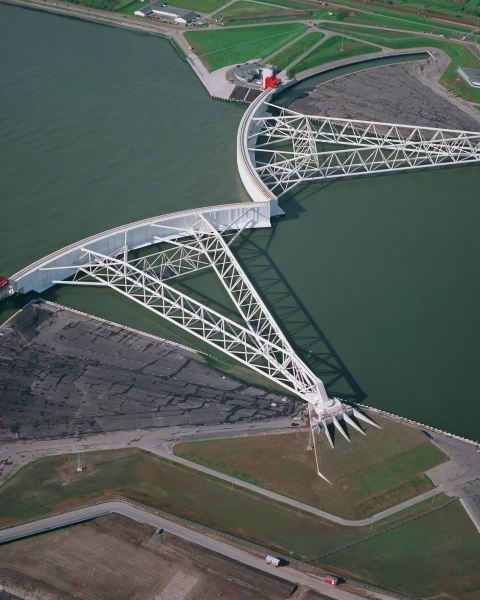
Arno continues: “In the context of this SOFD, we, as Iv, provide failure probability analyses for the storm surge barriers. We update these analyses, participate in specific failure probability-oriented studies, conduct evaluations and contribute to the preparation of the half-yearly failure probability reports. Our contribution goes far beyond the technical condition of the barriers. For example, we are also involved in developing the so-called KOMPAS, a tool developed by the Directorate-General for Public Works and Water Management to assess the softer (mainly organisational) aspects of risk-based management and maintenance of barriers.”
Thanks to this expertise, Iv is often used as a knowledge partner in other projects and programmes, such as research into the impact of climate change on the reliability of storm surge barriers. Iv has also worked with HKV Lijn in Water and Witteveen+Bos on the Sea Level Rise Knowledge Programme. Together, we are protecting the Netherlands from flooding, now and in the future!
Arno, managing director Asset Management, would be delighted to discuss this with you! Get in touch via +31 88 943 3200 or send a message.