Vision-based rapid dike reinforcement: Havendijk, Den Helder
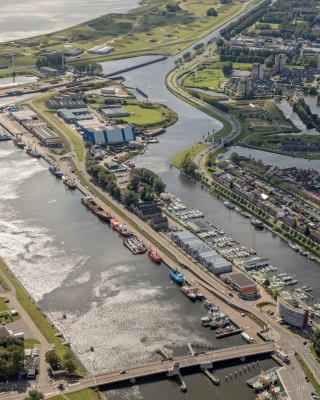
A unique dike reinforcement project is underway at the Havendijk in Den Helder. It concerns a relatively short stretch of dike, but the task is challenging. While a traditional dike reinforcement project of a primary flood defence takes eight years from exploration to completion, here, only half the time has been allocated for exploration and plan development.
The Havendijk in Den Helder no longer meets safety standards and has, therefore, been included in the High Water Protection Programme (HWBP). Water safety is an urgent concern along the middle section of this stretch of dike. The urgency is caused by the dike no longer meeting the outward stability requirements and the condition of the sheet pile wall in this section being particularly poor. The Havendijk project area is a dynamic location where various interests converge. The flood defence is located opposite the naval base and is close to residential areas, directly bordering existing harbour terrain with planned expansions. Traditional phasing, with research and design steps spanning many years, was not an option. The Hollands Noorderkwartier District Water Control Board decided to speed up the dike reinforcement project, requiring the exploration to be completed within a year. A challenge that was awarded to the Iv & TAUW consortium. A project team was formed in collaboration with the Hollands Noorderkwartier District Water Control Board, with all three parties contributing their specific expertise.
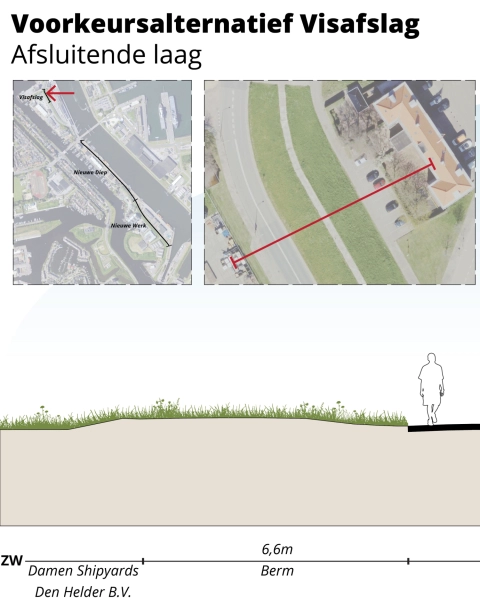
Although the Havendijk project is relatively small in size – 655 metres – it features a great deal of technical variation. Each section requires a specific approach. For example, at the northern end of this stretch, near the Visafslag (fish auction building), the dike includes an earth-retaining structure. The revetment will be adjusted here by excavating the existing top layer and applying a new, less permeable clay layer. This measure enhances the stability of the dike without altering the original form or the landscape’s appearance. This solution will be combined with a structure at the foot of the dike.
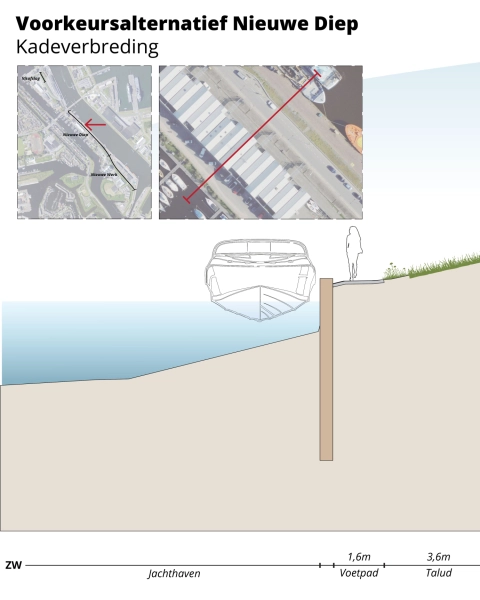
The middle section is the most technically demanding and challenging part of the dike. Here, there is a severely damaged sheet pile structure located directly along the harbour quay. In addition, the Port of Den Helder (the area’s manager) and the municipality of Den Helder also expressed a clear desire to expand the harbour area. So, instead of performing two separate interventions, an integrated approach was chosen: the existing quay will make way for a new combi-wall structure built from heavy sheet piles with deep anchoring – robust enough to moor larger vessels safely. By moving the quay outwards, approximately 5,000 square metres of new land can be made available for use as work or storage space
In addition to reinforcing the dike, the project also provides immediate added value for the surrounding area. In other projects, such opportunities often cause delays because the decision-making or financing process gets held up. However, this issue was deliberately addressed in this project by ensuring that the planning process took the lead. From the outset, the project team established clear rules: opportunities are welcome, provided the initiators actively participate, arrange their financial contribution on time, and record any administrative agreements. The dike reinforcement will not wait. This approach ensured that all involved parties were engaged from the outset, collaborated effectively and adapted swiftly. As a result, it was possible to include the expansion of the harbour area in the project in a relatively short lead time.
The entire exploration phase in just one year? Mission accomplished! The project team had a head start thanks to their knowledge of the area from previous projects. Some information regarding a section of the dike had already been collected, which was beneficial for the Havendijk project.
The team emphasises that bypassing steps did not achieve this level of speed – but by fundamentally changing the way the work was approached. According to them, the key lies in the form of collaboration. Rather than having separate parties with separate responsibilities, the project team is a close-knit unit in which knowledge and expertise are paramount. In practice, this means joint working days, sharing schedules, fostering trust, mutual respect and equality.
The most important thing is the attitude of the team members. This project has given substance to the slogan: the whole is greater than the sum of its parts. Job satisfaction and equality are fundamental. A conscious choice was made for professionals who thrive on working at a high pace, who are flexible in their approach to work, and who do not quickly revert to traditional working methods. This mentality makes a big difference in daily practice.
Decisions are made by the people who work on it daily, and problems are addressed immediately. At the same time, the team keeps a close eye on the reason behind their work: does an action actually contribute to the project goal? No? Then, it is immediately dropped. This goal-oriented and reflective approach keeps the project moving and ensures the pace remains high, even when obstacles are encountered.
Despite the tight schedule, the project team successfully integrated sustainability into the design. A key focus is the reuse of materials that become available during the work, such as clay, soil, and existing structural components, including sheet pile walls and concrete. It is already examined during the exploration phase whether these materials are suitable for recycling or reuse within the project, for example, as a filling material or in the new dike revetment. Additionally, it is investigated whether regional stakeholders – such as the Port of Den Helder, the municipality of Den Helder, or initiators of other infrastructure projects – could benefit from the released materials. In doing so, unnecessary transport and waste flows are prevented while contributing to a circular approach to the project. Sustainability is also taken seriously in the implementation preparation: the focus is on using as much emission-free equipment as possible and implementing smart phasing to minimise transport movements.
The preferred alternative has now been decided upon administratively. Over the next few years, the project team will work towards implementation during the plan development phase. The awarding of the contract is planned for 2026, with the aim of commencing work on site in 2027. If everything goes according to plan, the dike will be reinforced by 2028 and will once again meet the required standard. A trajectory from exploration to realisation in just five years. That is extremely fast, especially for reinforcing a primary flood defence involving various designs and different stakeholders in the dike’s vicinity. The Havendijk project proves it is possible to accelerate a project without compromising its content. And when the dike is water-safe again, a safe, future-proof flood defence will remain – as well as an approach from which other projects can draw inspiration.
Wouter, managing director Infra and also COO of Iv, would be delighted to discuss this with you! Get in touch via +31 88 943 3200 or send a message.