Decentralised hydrogen production plants
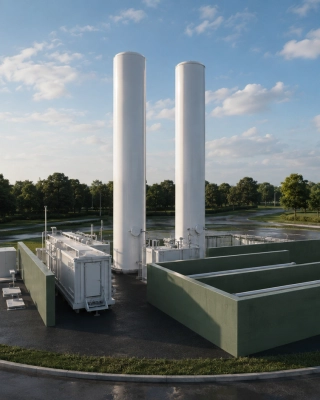
Within the development of decentralised hydrogen production, Iv has carried out studies into hydrogen plants in 2-5 megawatt range. The studies aim at the use of locally generated renewable energy for mobility and industrial applications. These plants combine multiple energy systems, including grid connections, solar power and battery energy storage systems (BESS), to maximise the use of green electricity and optimise hydrogen production while minimising production costs.
The electricity generated is used for electrolysis, producing high-purity hydrogen, which is subsequently compressed, stored and distributed via tube trailers to end users such as refuelling stations. In addition to transport, these trailers also form part of the system’s logistical buffering, with filled trailers transported to end users and empty trailers returned to the production plant for refilling.
Within these studies, Iv focuses on the integral design of the complete installation, including the balance of plant, within an EPC context in collaboration with suppliers of electrolysers, compressors, and storage filling systems.
In this type of installation, hydrogen production is primarily determined by the availability of solar energy. As a result, the electrolyser, in which electricity is converted into hydrogen, follows a variable production profile. Additional energy sources, such as a grid connection and BESS, are used to support the energy supply. This means hydrogen production fluctuates, whereas processes such as compression and distribution operate most efficiently under stable and continuous operating conditions.
System integration between the electrolyser, compressor and smart control systems is therefore a key aspect of the design. By carefully aligning these components, the number of start-stop cycles can be reduced, allowing the installation to operate more efficiently.
Additionally, a buffer tank has been installed between the electrolyser and the compressor, ensuring a more stable load on the compressor. This reduces the frequency of start-up and shutdown cycles, resulting in lower electricity consumption and a extended compressor lifecycle.
The quality of the existing water supply network has also been assessed for electrolysis suitability. Any contaminants are filtered to ensure the water quality meets the electrolyser requirements, preventing contamination and fouling within the equipment, particularly the membranes. In summary, the entire process chain, from energy input to hydrogen output, is taken into account, resulting in high availability and consistent quality of hydrogen.
The installation makes it possible to convert locally generated renewable energy into a transportable energy carrier, creating a direct link between energy generation and end-use applications such as mobility.
By combining multiple energy sources with an optimised system configuration, hydrogen production can also be applied in situations with variable energy input. This enables hydrogen production and distribution on a smaller scale for applications such as transport refuelling stations.
The modular, containerised design allows the system to be deployed flexibly and expanded in phases. The same design principles are also relevant for other applications, including offshore hydrogen production. In these systems, the coordination between variable energy input, electrolysis, compression and storage plays a similar role, but at a larger scale and under more demanding operating conditions.
Through these studies, Iv provides insight into how hydrogen plants can be designed and operated, with system integration and configuration choices playing a key role in performance, energy consumption and cost efficiency.
Fedor, managing director of Offshore & Energy, would be delighted to discuss this with you! Get in touch via +31 88 943 3300 or send a message.