Underground gas storage facility
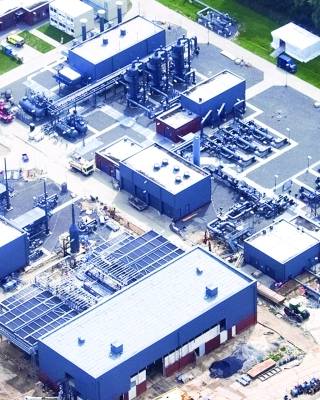
Gas Storage Epe (EPE) is an underground gas storage facility in Germany. It has been developed to increase flexibility and security of supply within the Northwest European gas network. Gas is stored in salt caverns at a depth of approximately 1.2 kilometres, created by salt mining. Commissioned by Nuon Energy (now Vattenfall), the storage capacity was expanded through the development of additional salt caverns and associated above-ground installations.
Within this project, Iv, in collaboration with Visser & Smit Hanab, was responsible for the engineering and design of the installation, together with procurement, inspection and supervision during construction and commissioning, under an EPC contract. The expansion included the realisation of additional compression capacity, including associated installations and approximately 6 kilometres of transmission pipeline, required to efficiently inject and extract larger volumes of gas.
The installation is connected to both the Dutch high-pressure gas transmission network (GTS) and the German network (OGE), enabling cross-border gas injection and extraction flows. Part of the project involved the installation of two electrically driven centrifugal compressors (2 × 9 megawatts), configured in a two-stage arrangement.
The expansion took place within an operational installation, requiring careful phasing of design and execution in order to maintain system availability. Connections between the existing and new installations were implemented without disruption to ongoing operations.
New compression installations, pipelines and process systems, including civil, mechanical and E&I works, had to be integrated into the operational installation. This placed high demands on safety, availability and coordination between various technical disciplines and interfaces.
Additionally, pressure levels, capacities and control strategies had to be closely aligned. The installation had to be suitable for both injection and extraction processes, involving varying flow directions, flow rates and pressure levels. The variability in operating conditions, such as fluctuations in gas flows and storage cycles, placed additional requirements on the installation design.
The expansion resulted in an increase in storage capacity from 140 to 220 million m³ and significantly increased the injection capacity by a factor of five. Additionally, the number of caverns increased from four to seven. This allows gas to be injected and extracted more rapidly, enabling the system to respond more effectively to fluctuations in supply and demand. As a result, the flexibility of the network is increased, contributing to security of supply within the Northwest European gas network.
Gas storage facilities such as Epe therefore play an important role in balancing peaks and shortages within the energy supply system. In the current market, where domestic gas production is declining and dependence on imports is increasing, this contributes to the operational stability of the energy system.
Underground storage facilities such as this are also associated with future applications, such as hydrogen storage. This requires similar principles regarding compression, storage, and system integration, but simultaneously places additional demands on material use and design.
Underground storage facilities such as this are also associated with future applications, including hydrogen storage. While this involves similar principles in relation to compression, storage and system integration, it also places additional demand on material uses and installation design.
Fedor, managing director of Offshore & Energy, would be delighted to discuss this with you! Get in touch via +31 88 943 3300 or send a message.