Grebbedijk integrated area development
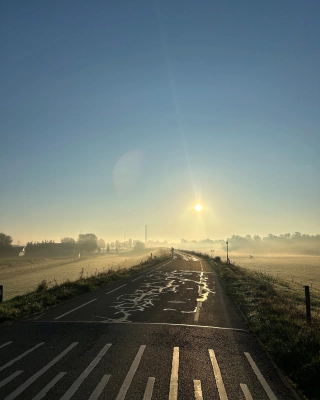
The centuries-old Grebbedijk, located between Wageningen and Rhenen, is on the brink of a major reinforcement project combined with a forward-looking regional development initiative. Although the dyke is relatively short at 5.5 kilometres, it plays a crucial role in ensuring water safety. A breach would have severe consequences, with floodwaters potentially reaching as far as Amersfoort. The project has therefore been given national priority within the High Water Protection Programme (HWBP). On 31 October 2025, contractors Boskalis Nederland and Wetering signed the contract for the implementation of the Grebbedijk regional development project together with the Vallei and Veluwe Water Authority. Iv is working with the consortium to develop the integrated design.
In 2017, new water safety standards were incorporated into the Dutch Water Act. These new standards not only assess the strength of the dyke itself but also take into account the potential damage caused by a breach. In that same year, the Vallei and Veluwe Water Authority reassessed the Grebbedijk and concluded that it no longer met the current water safety requirements. This project will reinforce the dyke in a sustainable and future-proof manner, ensuring that it complies with the statutory safety standards and continues to provide protection against high water levels in the Lower Rhine for years to come.
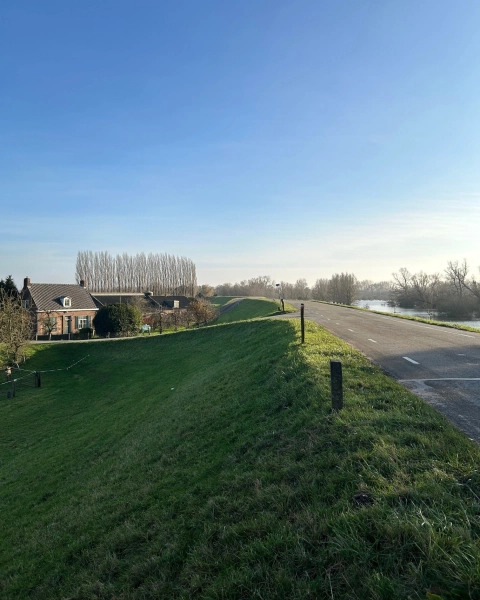
The regional development associated with this project is both exceptional and complex in many respects. While water safety and the dyke reinforcement challenge take centre stage, the opportunity is also being taken to enhance the surrounding natural environment and make the area more attractive for recreation. This includes demanding components such as the demolition of the Witte Sluis (an old drainage sluice), the integration of longitudinal structures and embankments near heritage buildings like the Dijkmagazijn, the Rijnschans and the Dijkstoelhuis, and the design of a WFD channel for the implementation of the Water Framework Directive (WFD) measures. The WFD stipulates that water must provide a suitable habitat for the plants and species native to the area.
Space is limited in the Grebbedijk reinforcement zone, particularly near buildings and monuments. We are engineering new longitudinal structures, such as steel sheet piles, by carrying out precise calculations to determine the most suitable type, length, strength, and location. Existing structures within the dyke are also thoroughly analysed to ensure they meet the safety requirements projected for the year 2075.
In the rural area, the challenge lies in integrating the support berm in a way that best aligns with the ambitions set out in the spatial quality framework. To address the piping failure mechanism (the formation of sand-carrying boils), the design team is evaluating the most appropriate (vertical) solution: a heave screen, vertically installed sand-tight geotextile, a coarse sand barrier, or a synthetic filter screen.
A key principle in the implementation of this project is to deliver a sustainable dyke, with minimal environmental impact during both construction and maintenance. The dyke will be constructed as circularly as possible, with innovations playing a significant role. For instance, innovations in the preliminary phase led to a substantial reduction in the required dyke height. From a sustainability perspective, as much existing material as possible will be reused on-site, including soil, sheet piles, and grass coverings. A test pile driving trial will also be carried out to determine in advance the best construction method in terms of minimising nuisance (vibrations and noise) for the surrounding area. The results of the trial will be fully integrated into the design, and alternative construction methods will be chosen where necessary to minimise disruption to the local environment.
With the contract for the project awarded to the BoskalisWetering consortium (operating under the name Konikswaard), the first step in the implementation phase has been taken. In the coming period, the integrated and detailed execution designs will be developed. Construction activities on site are scheduled to begin in early 2027. The aim is to complete the project by no later than 2030.
Wouter, managing director Infra and also COO of Iv, would be delighted to discuss this with you! Get in touch via +31 88 943 3200 or send a message.