Lowering the cost price of green hydrogen through decentralised ammonia conversion
Hydrogen projects in the Netherlands frequently stall as a result of the associated high costs. The Levelized Cost of Hydrogen (LCOH), which largely determines the economic feasibility of a project, constitutes a major barrier to development of hydrogen solutions. These costs are determined by technology and, to a considerable extent, by the structure of the hydrogen chain. As such, this is precisely where opportunities to reduce the LCOH can be found, for example, through the decentralised conversion of ammonia (NH3). For this, Escher Process Modules, part of Iv, has developed a solution to make green hydrogen locally available in the short-term.
While industry has a growing need for environmentally friendly alternatives, market analyses reveal local production of green hydrogen by electrolysis to be between €12 and €14 per kilogramme in the Netherlands. By way of comparison, achieving green hydrogen via imported ammonia sees the cost price fall to below €8 per kilogramme.
The high cost price associated with local production of hydrogen from electrolysis results from the cost of renewable electricity (Power Purchase Agreements (PPAs)), infrastructure, and the scale of electrolysis plants. Additionally, large-scale electrolysis requires heavy-duty grid connections. At the same time, parts of the Netherlands are experiencing grid congestion, which limits, and in some cases prohibits, the required increase in electricity capacity. As a result, electrification is not always feasible, despite the industrial drive towards increased sustainability.
The production of 1 kilogramme of hydrogen via electrolysis requires approximately 50 to 60 kilowatt-hours of electricity. With conversion via ammonia cracking, energy consumption is significantly lower, at around one-tenth of this. As a result, the pressure on the grid is considerably reduced for the production of a comparable volume of hydrogen.
A profitable business case for hydrogen begins with availability of renewable energy at a competitive price. Contributing to the challenge is that Europe is anticipated to produce insufficient volumes of renewable energy to meet future demands. Additionally, in the Netherlands, supply of wind- and solar generated energy is limited relative to potential demand. This makes production in regions with a more favourable climate a logical option.
Transporting this energy across long distances, however, presents both a technical and logistical bottleneck. Hydrogen transportation via pipelines faces geographical limitations, while shipping is unattractive due to hydrogen’s low energy density. Ammonia, on the other hand, presents a number of advantages that ensure its suitability for intercontinental transport by ship. For one thing, ammonia has a relatively high energy density. It can also be liquefied relatively easily at moderate pressure or low temperature.
To demonstrate, approximately 130,000 litres of hydrogen compressed at 350 bar are required for an equivalent of 100 megawatt-hours of energy. By way of comparison, the same amount of energy requires in the region of 23,000 litres of liquid ammonia. The result of this is fewer transport movements and, therefore, lower logistical costs, making ammonia a practical alternative to hydrogen for transportation over long distances.
The chemical industry has been producing and transporting ammonia on a large scale for over 100 years. As such, storage, transport and handling solutions have already reached technical maturity, and safety standards for managing risks such as toxicity are well-established.
To make green hydrogen available to end users such as transport companies, inland shippers, and industrial clusters in the short term, a decentralised approach is the most practical solution. Rather than producing hydrogen centrally and distributing it in a complex manner via pipeline or road transportation, the chain can be configured around the conversion of ammonia to hydrogen close to the consumer’s location.
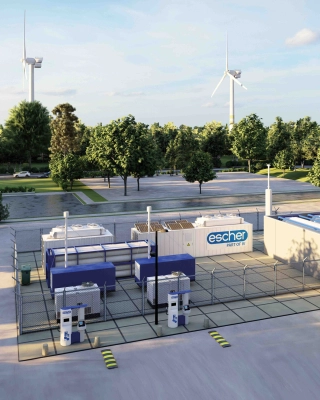
Escher Process Modules, has developed a technology for the decentralised conversion of ammonia to green hydrogen. In this process, ammonia is converted into hydrogen near the point of use. This allows for a reduction in both the transport of gaseous hydrogen and heavy-duty electricity connections.
Local conversion reduces the need for large-scale hydrogen distribution. This creates additional flexibility in infrastructure design and allows for local availability of hydrogen with relatively limited grid capacity. This is particularly relevant at a time when grid congestion is limiting the expansion of electricity capacity in many locations. It is specifically the combination of existing infrastructure with scalable logistics that makes ammonia as an energy carrier so well-suited to international transportation.
When these cost factors are all considered together, a clear picture emerges of what is needed to make hydrogen economically viable at the site of use. The development of the Escher ammonia cracker was based on these principles. The ammonia cracker consumes less than one-tenth of the energy required to make the same amount of hydrogen available locally via electrolysis. With this ammonia cracker, depending on configuration and boundary conditions, an LCOH lower than €8 per kilogramme can be achieved.
This decentralised installation, configured as a standardised plug-and-play unit, delivers hydrogen with a purity of 99.97%, in accordance with the ISO 14687 standard for fuel cells. The process splits the ammonia into hydrogen and nitrogen (N₂). Following further treatment, the nitrogen can be safely released into the atmosphere. Additionally, as ammonia contains no carbon, no CO2 is released during the conversion.
With local production taking place at, for example, refuelling stations or industrial sites, it is possible to make hydrogen available in locations where electrification would be complex, or where no hydrogen network is yet in place. This provides an alternative for locations that fall outside planned hydrogen networks, or where large-scale electrification is not feasible. As a result, it becomes possible to decarbonise sectors for which sustainability remains a challenge.
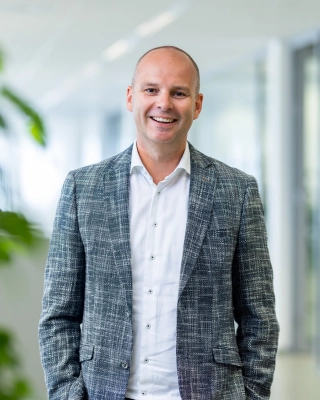
Martijn, managing director of Escher, would be delighted to discuss this with you! Get in touch via +31 88 943 3600 or send a message.