The future of bridge assessment is real-time
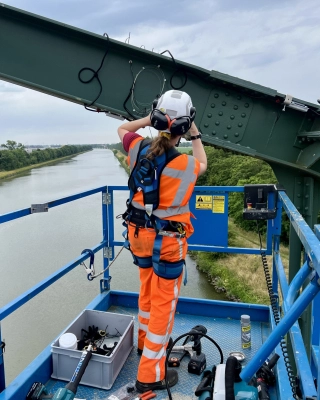
Bridges, locks and viaducts designed and built decades ago are gradually approaching the end of their original design life. But when does a structure really need to be replaced? And how can you be sure that a bridge is still safe to use? Iv’s new real-time assessment system (RTA) gives asset managers continuous insight into the actual loads and condition of their structures. By combining sensor data with advanced computational models, the system provides an accurate picture of a bridge’s remaining service life.
Consider a provincial bridge designed thirty years ago for an anticipated traffic volume comprising a certain number of cars and lorries each day. A few years later, a large industrial estate opens nearby. As a result, traffic patterns change completely. There are more vehicle movements, larger and heavier lorries, and loads far exceeding those allowed for in the original calculations.
“New bridges are designed on the basis of future projections,” explains Garry Vandeburg, Senior Consultant at Iv. “The design process predicts how much traffic will use the bridge and how heavy that traffic will be. But what happens if reality does not match those assumptions?” The actual loads may be considerably higher than anticipated, or much lower. Yet maintenance and replacement decisions are still often based on calculations made decades ago. “For many asset managers, this is one of the greatest challenges they currently face,” says Garry Vandeburg.
Assessing the structural condition of a bridge requires regular inspections and additional calculations. This often starts with extensive desk research. Engineers gather and analyse drawings, calculations, inspection reports and maintenance records to build the most complete possible picture of the structure.
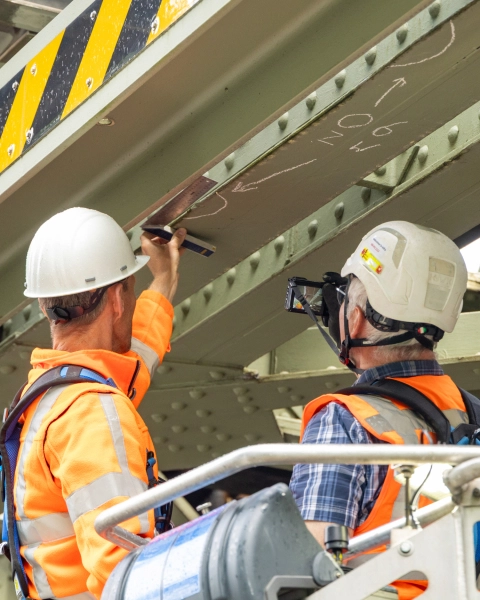
Iv developed its real-time assessment system (RTA) to provide continuous insights into how a bridge or other structure behaves in practice. Permanent sensors installed on the structure continuously collect data on actual loads and structural behaviour. “We are making bridges and locks smart,” explains Garry Vandeburg. “Instead of taking occasional measurements, we continuously collect information about the loads acting on the structure and how it responds.”
The process consists of four key elements: measurement, monitoring, analysis and forecasting. Sensors at strategic locations record deformation, strain and loads. The resulting data is automatically connected to a digital computational model, which is continuously updated with new measurements. “You can compare it to an advanced set of weighing scales,” says Garry Vandeburg. “The sensors provide the input, and the computational model translates that data into information about the condition of the structure.” This creates an up-to-date and increasingly accurate picture of how a bridge or lock actually behaves and what its remaining service life is.
Iv’s real-time assessment system (RTA) combines high-frequency fibre-optic sensors with advanced finite element models (FEM). A digital computational model is developed for each structure. The structure is divided into thousands of small elements, providing a detailed picture of how forces, stresses and deformations are distributed throughout it.
The fibre-optic sensors continuously measure how the structure behaves in practice. Even minimal deformation and material strain can be detected through changes in the light signals travelling through the optical fibres. The measurement data is automatically fed back into the FEM model. By continuously comparing real-world measurements with calculated values, the system builds an increasingly accurate picture of the bridge’s actual condition and the rate at which fatigue is developing. In effect, the model learns how the bridge behaves under today’s traffic intensity rather than the traffic for which it was originally designed.
"A robot vacuum cleaner knows when your home needs cleaning, and a smart thermostat makes sure it is warm when you return. So why should bridges and locks continue to rely solely on historical records and periodic inspections?"
As far as Iv is concerned, that time has passed. The real-time assessment system is already being applied to an aluminium test bridge equipped with sensors and monitoring technology. Engineers, structural engineers, inspectors, data specialists and machine-learning experts are working together on its further development. Students and researchers from technical and mathematical disciplines are also contributing.
Over the years, we have built up an impressive track record of infra & water structural integrity assessment projects.
Arno, managing director Asset Management, would be delighted to discuss this with you! Get in touch via +31 88 943 3200 or send a message.