App accelerates regional flood defence upgrades
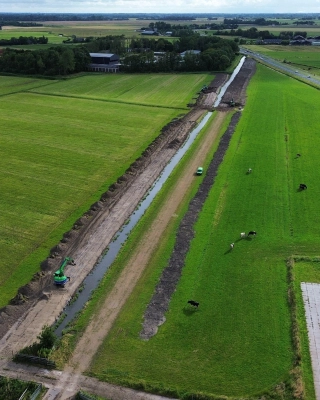
In the Netherlands, thousands of kilometres of regional flood defences, also known as storage-basin quays or polder dykes, have to be periodically raised or reinforced. Asset managers therefore need rapid insight into which measures are spatially feasible, how much material is required and what impact a design will have on the surrounding area. To make this process more efficient, engineering company Iv has developed an app to upgrade regional flood defences. The app can be used to carry out an area-wide height assessment. Where necessary, it can then be used to create a simple outline design for the required raising or strengthening works. This approach offers asset managers a range of benefits, including greater efficiency, improved quality, and increased agility and flexibility in the design process.
Water authorities are legally obliged to periodically assess their flood defences against the applicable standards. In settlement-sensitive areas, such as peatlands, dykes gradually subside due to autonomous settlement. As such, if water levels remain the same or rise, they may no longer provide sufficient height. Increasing loads can also mean that a flood defence is no longer strong enough. Managing thousands of kilometres of regional flood defences is therefore a continuous and labour-intensive process. However, raising dykes is not straightforward: stability, subsoil conditions, water levels, available space, and environmental factors such as nature and recreation must all be considered simultaneously.
Traditionally, a dyke reinforcement project starts with a great deal of manual work. Elevation data is collected, a 3D model of the existing situation is created, and various design options are assessed integrally by several disciplines, including water safety, geotechnical engineering, structural hydraulic engineering, spatial planning, sustainability, conditioning and stakeholder management. This takes time, coordination and money, while the first phase is often still exploratory in nature. The dyke-raising app makes it possible to quickly create area-wide outline designs at an early design stage, so that options are immediately clear and open for discussion without the need for final calculations. This increases accuracy and, consequently, reliability.
When using the app, the first step is to upload a reference line showing the alignment of the existing dyke or quay, for example from a CAD or GIS file. Elevation data is then added. This can be taken from the Actueel Hoogtebestand Nederland (AHN), the Dutch national elevation dataset, which is updated periodically, or from the user’s own, more detailed survey data. Based on this data, the app visualises the current situation. Additional information can also be added, such as locations where the dyke must not be expanded, existing or planned buildings, watercourses or other spatial constraints. These data are not automatically included in the calculation, but are essential for properly assessing the design at a later stage.
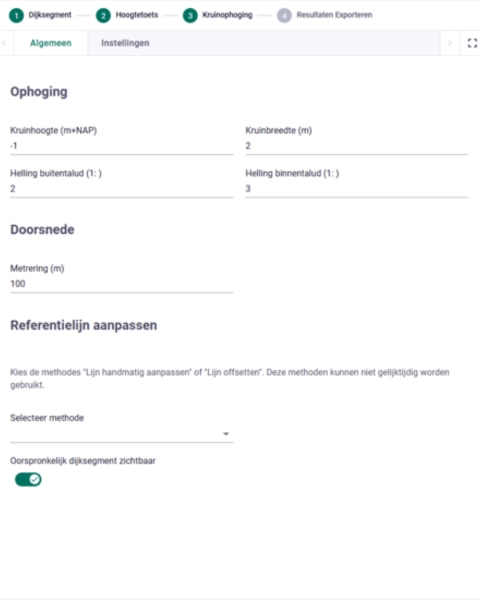
The app makes it possible to quickly explore a new situation. The user enters a number of key parameters, such as the required crest level, for example 0.2 or 0.3 metres above NAP (Normaal Amsterdams Peil/Amsterdam Ordnance Datum), the crest width and the gradients of the inner and outer slopes. Based on these data, the app calculates what the dyke will look like, both in cross-section and in plan view. For example, an asset manager may want to make the slope steeper or shallower, raise or widen the crest, avoid affecting a road or house, or retain a ditch and agricultural land. Within seconds, the app produces a clear outline design, including the required quantity of fill material, the space occupied by the measure and potential interfaces with water or the surrounding environment. This allows design options to be discussed directly with the client, either at their office or via Teams. What would normally require extensive coordination and time is made immediately clear.
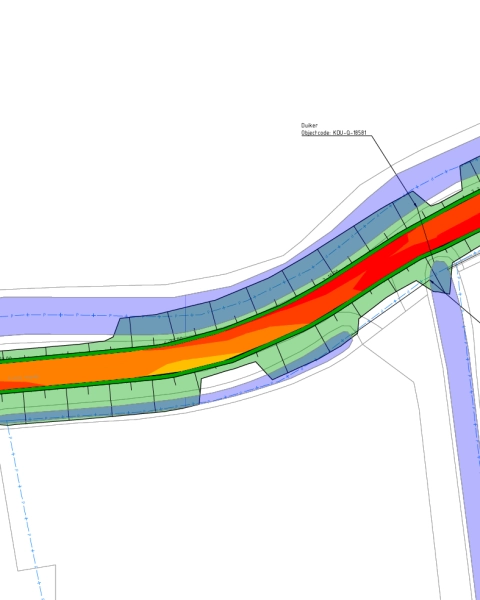
For the storage-basin system managed by Hoogheemraadschap Hollands Noorderkwartier (HHNK) (water authority in the Province of North Holland), the flood defence app was applied to dozens of kilometres of storage-basin quays. In this area, the difference between the water level and the hinterland is often only 30 to 50 centimetres, with a complex network of waterways and agricultural plots. Using the app, we were able to provide rapid insight, through outline designs, into where raising measures were technically feasible, what impact an intervention would have on the surrounding area, and where bespoke solutions would be required. This was achieved without having to produce full 3D designs, making it possible to assess the viability of a measure, together with its budgetary and spatial implications, as early as the exploratory phase.
Another example is a low-lying area in North Holland, directly behind the coastal dune area, where rainfall can either infiltrate towards the sea or run off towards the polder area behind it. The area contains agricultural land used for grass and flower cultivation, intersected by roads and ditches that drain the water. Due to its location, the area is prone to flooding. This issue has increased significantly in recent years and is the reason for a regional programme aimed at the controlled drainage and management of water. A potential subsidy also played a role in this project, meaning that the viability of possible measures had to be assessed quickly. Here, the app was used to assess variants at an early stage and immediately identify the required soil volumes, allowing a subsidy application to be submitted. This showed, for example, that some variants, such as raising works that would affect an existing ditch or road, were technically feasible but not viable because of their impact on water drainage or agricultural land.
Projects increasingly require rapid visualisations and drawings. With the flood defence app app, consultants can prepare outline designs themselves and explore bottlenecks without depending on detailed design development. The lines and profiles generated can be used directly as 2D drawings, enabling ideas to be shared quickly within the project team.
The main value of the app lies in its speed, flexibility, and reliability. Changes to design parameters, such as a revised construction height or slope gradient, can be implemented at the touch of a button. The consequences of these amendments are immediately visible across the entire process. Whereas traditional drafting can take days or even weeks to incorporate changes, this can now be done in minutes. Depending on the project, time savings of up to approximately 60% can be achieved in the exploratory design phase. Additionally, reliability is improves because the design is no longer based on a small number of critical cross-sections, but on area-wide data.
The results from the app are not the end point. The designed dyke alignment and cross-sections can be exported as shape files and used as input for further design software. In this way, the outline design forms a starting point and connects with existing workflows. The app is particularly effective in relatively straightforward situations, such as rural or open areas where there is little development directly adjacent to the dyke. In more complex urban environments too, the app adds value by providing insight into potential solutions in an early phase. The app provides a basis for further development and detailing in preliminary and final designs, with additional bespoke engineering where required.
Above all, this flood defence app shows how digitalisation can accelerate and strengthen the work. It does not replace expertise, but automates repetitive tasks and makes insight available more quickly.
Wouter, managing director Infra and also COO of Iv, would be delighted to discuss this with you! Get in touch via +31 88 943 3200 or send a message.