Floating HVAC offshore substation
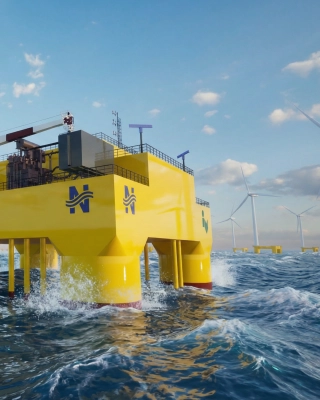
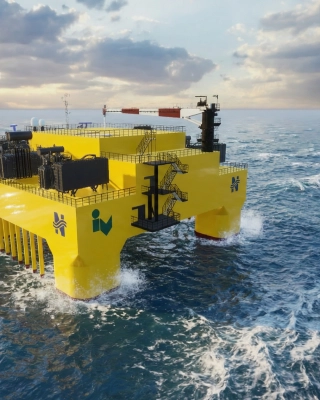
Iv and Nevesbu have developed a floating HVAC substation design to connect offshore wind farms in deep waters to the electricity grid. The substation provides an overall capacity of 1,000 MW or more and is suitable for water depths up to 1,500 metres. The platform is based on a proven semi-submersible base that is adaptable to various water depths and soil conditions. The design can be tuned for specific environmental conditions, from moderate Mediterranean climates to harsher environments such as typhoon-prone regions in Asia. While our floating HVDC variant is also in constant development for future long-distance requirements, the HVAC design offers the most feasible solution for near-term application.
The electrical system steps up voltage from 66 to 220 kilovolts using existing, certified high-voltage equipment. This design integrates several patented innovations and has been validated through model testing under extreme conditions, such as a 1-in-100-year event with wave heights exceeding 17 metres.
As shallow-water sites become scarcer, offshore wind is moving into deeper waters where wind conditions are stronger and more consistent. The primary challenge is not generating this energy, but bringing it to shore reliably and affordably. Floating solutions introduce additional complexity. Dynamic motions, additional load cases, and system integration challenges go beyond traditional fixed designs.
Standard electrical equipment is not typically designed to withstand continuous motion and high accelerations. It is therefore critical to manage the interaction between the floater and the equipment to ensure peak accelerations remain within strict supplier limits, even in extreme 1-in-150-year conditions. Furthermore, the substation must maintain operational availability to ensure power transmission whenever the turbines are active.
This design provides a cost-effective and modular solution that enables the expansion of deep-sea offshore wind. The design is focused on simplifying construction, the design facilitates parallel modular fabrication, which accelerates the project timeline. Logistics are further streamlined as the substation can be towed to the site, eliminating the need for expensive heavy-lift vessels.
The platform is engineered for long-term reliability of a minimum service life of 30 years, using proven offshore technologies and integrating operation and maintenance requirements into the design. Access is provided via walk-to-work vessels, with helicopter support for emergencies, onboard cranes, and remote monitoring from shore. This allows control over execution, installation, and long-term operation in the world’s most challenging waters.
Our designs are not just theoretical. They have been developed, validated and tested, providing insight into offshore performance and behaviour. By applying proven technologies from other industries and innovative structural approaches, floating substations become technically feasible.
Fedor, managing director Offshore & Energy and also COO of Iv, would be delighted to discuss this with you! Get in touch via +31 88 943 3300 or send a message.