From ammonia to hydrogen: a new route to industrial decarbonisation
Industry wants to decarbonise, but energy supply is not keeping pace everywhere. Grid congestion is delaying the transition to electric production processes. Even when more grid capacity becomes available, the availability and cost of renewable electricity will remain decisive factors in the business case for many energy-intensive companies.
Many industrial companies will face important investment decisions in the coming years. Furnaces, boilers and other installations are reaching the end of their service life. Their replacement will determine how a company operates and which energy sources it requires for many years to come.
The recent NOS article on brick manufacturers and the Cluster 6 industrial strategy underline how grid congestion complicates these decisions. Companies want to decarbonise, but cannot always obtain a higher-capacity electricity connection in time.
According to Escher Process Modules, part of Iv, the challenge extends beyond the capacity of the electricity grid alone. For processes with high and continuous heat demand, the availability of sufficient renewable energy at a competitive cost is also an important factor. This raises a logical question: how can renewable energy be made available where it is needed?
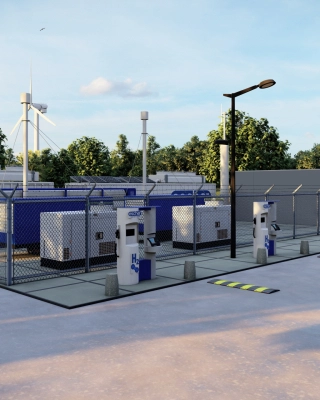
Hydrogen is one of the options. Escher is developing technology that converts ammonia into hydrogen on site for use in industrial production processes.
This decentralised approach makes hydrogen available locally, without requiring on-site electrolysis or a connection to a hydrogen network. Escher is therefore targeting industrial companies that want to reduce their natural gas consumption and need an alternative to full electrification.
Drawing on its expertise in process installations, gas treatment and system integration, Escher is translating this technology into a practical industrial solution. The site’s heat demand, operations and available space form the starting point.
For industries with high heat demand, such as the ceramics and glass industries, this offers an additional route alongside electrification—one that can be aligned with their production processes and investment planning.
Green ammonia can be produced in regions with favourable conditions for renewable energy generation. The energy can then be stored and transported to where it is needed. The ammonia cracker makes the hydrogen available locally. This approach offers:
Escher’s ambition is to give industrial users more options for reducing their natural gas consumption. Connecting international energy supply with local conversion creates an additional route to decarbonisation, including for companies outside the major industrial clusters. In this way, Escher combines specialist process expertise with the potential of ammonia as an energy carrier to develop solutions for the energy transition.
Martijn, managing director of Escher, would be delighted to discuss this with you! Get in touch via +31 88 943 3600 or send a message.