Every litre counts: working together to ensure sufficient drinking water
Drinking water companies are sounding the alarm. There is a possibility that in a few years, we will have a shortage of drinking water in the Netherlands. The media also often report on the quality and quantity of our drinking water. Recent headlines have read: “The shortage of drinking water in the Netherlands is already causing problems that are only set to worsen.” And: “Water company sounds the alarm: impending drinking water shortage.” But exactly how urgent is the drinking water issue in the Netherlands? And what is needed to continue to guarantee sufficient drinking water?
Iv talks to Vitens, the largest drinking water company in the Netherlands, about the biggest challenges and solutions that can tackle these challenges.
As stated in the media, a major challenge lies in the quantity of water. Demand for drinking water is growing faster than the supply. This is partly due to population growth and economic development. But climate change is also having a noticeable impact on our drinking water supply, a factor that is already causing problems. For example, since 2022, dozens of companies have not been given a drinking water connection. In addition, there are multiple drinking water companies in the Netherlands that no longer have sufficient reserve capacity, according to the Netherlands Court of Audit (Algemene Rekenkamer).
Further measures will be required to guarantee the future supply of drinking water. The way we currently use and consume water will have to change. Reducing demand is vital, and we must explore alternative drinking water sources. This is a complex challenge in which technology plays an essential role.
“Reserve capacity is becoming increasingly scarce in more places”
Another challenge relates to the quality of our drinking water. According to the National Institute for Public Health and the Environment (RIVM), not only is the availability under pressure but also the quality of the water suitable for drinking water production. This is partly due to discharges into surface water and climate change. A persistent drought leads to a decrease in the amount of available water, increasing the risk of salinisation. High temperatures warm up the surface water, causing an increase in unwanted bacteria. Heavy rainfall can also result in surface water becoming contaminated by wastewater. Additional measures are, therefore, needed to maintain good drinking water quality.
Vitens is currently carrying out a major project to increase drinking water capacity in Overijssel and improve water quality. The drinking water company produces over 360 billion litres of drinking water annually but is now reaching its limits. There is almost no reserve capacity for drinking water in Overijssel. Rik Dogger, spokesperson at Vitens, says: “People take it for granted that clean drinking water comes out of their taps at home. As a drinking water company, we are committed to ensuring this. It is our duty to do so, but action must be taken in the coming years to achieve this goal. We must work together to ensure we have enough drinking water in the future.” Vitens has observed that the situation is already dire in some areas. The drinking water company can still connect the new homes that are currently on the drawing board to the drinking water network, but probably not houses planned for construction afterwards. In the summer, when it is warm and dry for a long time, it is all hands on deck to ensure an adequate water supply from the tap. “This situation will occur in more and more places in the Netherlands,” says Rik. “So, we need to focus on producing more drinking water, and we need to explore whether the use of drinking water can be reduced even further to ensure sufficient availability for everyone.”
“Water companies, authorities and industry must collaborate”
The Netherlands has ten drinking water companies, each with its own business operations. This also means that the demand and issues faced differ greatly per water company. For example, drinking water may be extracted from groundwater in one area but from surface water in others. Iv is working closely with the different drinking water companies to solve these diverse issues. “As an engineering company, Iv helps drinking water companies search for and realise potential technological solutions to increase capacity and improve quality. We design technological solutions and convert these into integral designs. It is a complex task involving many elements because these solutions must consider legislation and regulations, the environment, and the integration of the client’s objectives while focusing on sustainability, safety, and availability. We have all the necessary disciplines and knowledge in-house for this. We are ambitious in seeking the best possible outcome for the challenge, and in doing so, we consider the entire water chain,” says Paul Kloet, managing director of Water at Iv.
The challenges in the field of drinking water are not limited to just one region or area. Therefore, the question is whether a national, uniform approach can provide solutions. Rik explains: “Vitens is actively seeking new sources to produce more drinking water. We are working with provinces and water boards to investigate where expansion is possible. This joint approach is crucial because if we fail, we cannot guarantee that we will be able to continue providing everyone with drinking water. Investigating with the provinces and water boards where expansion is possible is a shared endeavour. Once areas for expansion have been identified, we can get started. Then, every litre counts. It’s a matter of urgency.”
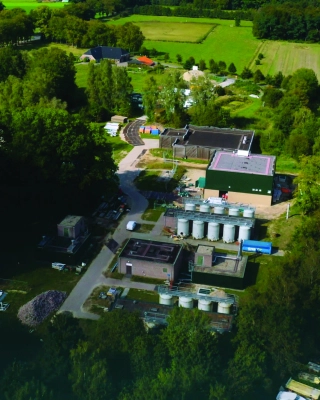
The Boerhaar water extraction site and Diepenveen production company are of great importance to Vitens. They supply Salland and Deventer with drinking water and thus form an indispensable link in the regional drinking water supply. But here, too, the demand for more drinking water is growing. After long, dry periods, it is becoming increasingly difficult to transport enough water to these regions. The production capacity will be expanded from 5 to 6.15 million cubic metres per year to meet the increasing demand. At the same time, the quality of the drinking water will be improved by adding an extra step to the treatment process.
“This project will create greater reserve capacity and reduce the use of chemicals”
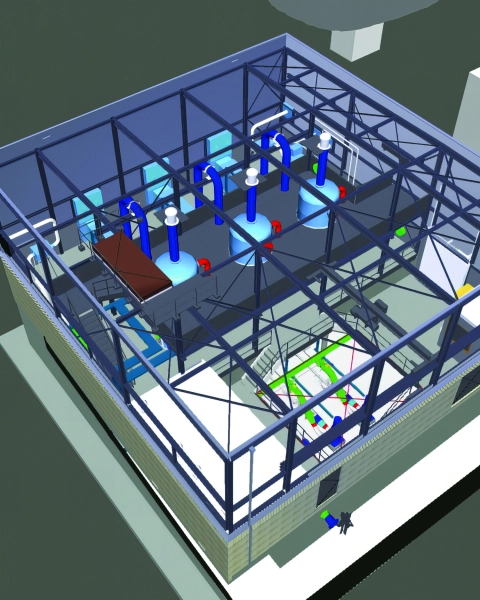
“Iv and Vitens have worked for years in the design phase on expanding and upgrading the Boerhaar and Diepenveen sites. A drinking water production company is quite complex in terms of installations. This project is extra challenging because adjustments are being made to an existing installation that must remain operational throughout the work. For this purpose, Iv designed, among other things, four new extraction wells, the connecting pipework, a completely new aeration building, an extension to the existing RO (Reverse Osmosis) building, a new energy building, a pre-filtration facility and a modification to the clear water reservoir,” says Guido van der Wedden, project manager at Iv.
Patrick Koenjer, senior engineer at Vitens, says: “The collaboration with Iv was mainly in the preliminary phase. Iv considered all the various disciplines during the engineering process. What would happen if we adjusted a component? What would the consequences be for the other systems? This coherence was continuously monitored to ensure nothing was overlooked from a technical perspective.”
Guido: “Our colleagues found it extremely valuable to combine the practical knowledge that Vitens employees have of the installations with our design expertise and experience working on projects for other drinking water companies. Teams can achieve much more by working together collaboratively rather than in the traditional client-contractor manner.”
Paul, managing director Water, would be delighted to discuss this with you! Get in touch via +31 88 943 3900 or send a message.