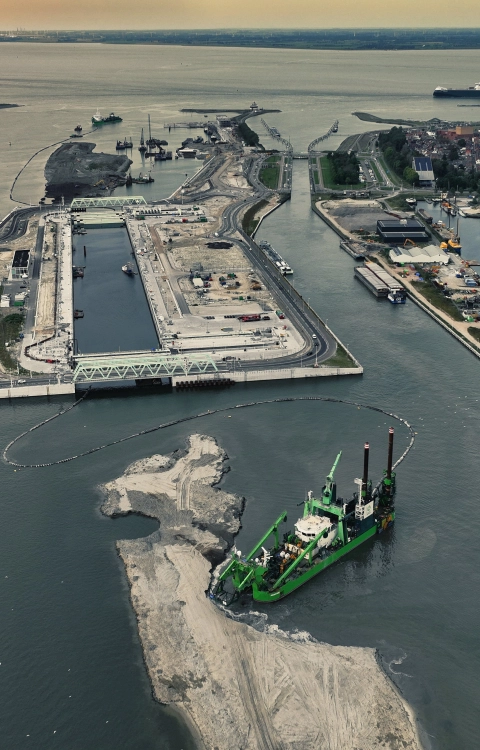
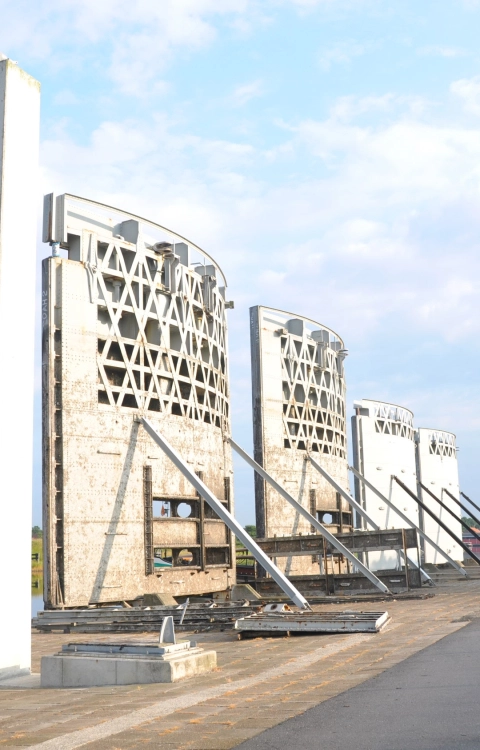
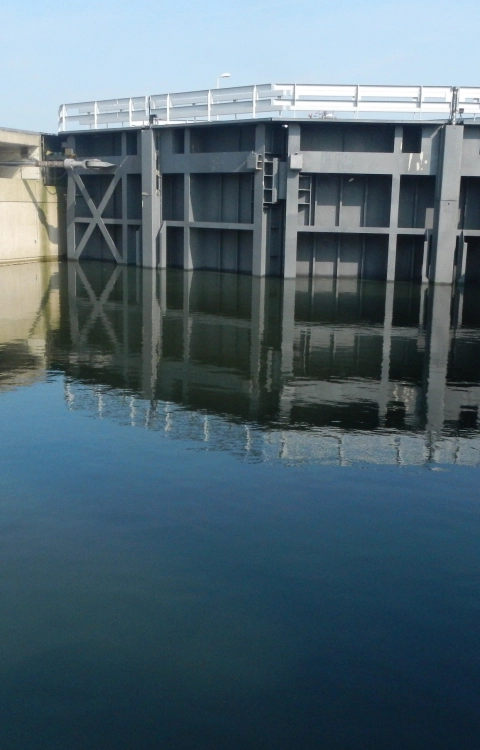
Curved sector gates for Södertälje Lock in Sweden
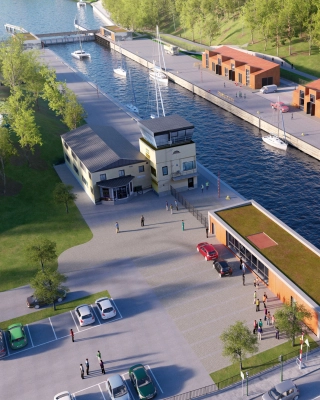
To accommodate growing maritime traffic in Sweden, the ageing Södertälje Lock required a major upgrade. Commissioned by the Swedish Maritime Administration (Sjöfartsverket), Züblin Scandinavia AB, MH Poly and Iv developed the design for the refurbishment and expansion of Scandinavia’s largest lock. Iv and MH Poly collaborated on the design of the new lock heads, including the curved sector gates and mechanical equipment, as well as the guide structures within the lock heads to protect the gate arms.
Fatigue performance and sealing are key considerations in the design of steel lock structures, particularly in the detailing of the buoyancy chambers, gate arms and main shafts. During every operating cycle, the buoyancy chambers move from the waterline to below the lock floor, subjecting the structure and the chamber stiffeners to significant cyclic loading. Internal ring stiffeners aligned with the longitudinal stiffeners on the outer plating were therefore adopted. Each side of the gate comprises six separate compartments, each fitted with an access hatch for inspection and maintenance.
The sealing system is another critical element of the lock gate’s performance. Leakage must be kept to a minimum while ensuring the required service life. Designing the bottom seal proved particularly challenging because of structural deformations, construction tolerances and stiffness requirements. The design was based on the principle that the gate must always bear against its end stops under the closing moment, thereby maximising the spring stiffness of the bottom seal. In addition, a circular double-lip seal was installed on both sides of the new gates. To reduce wear caused by gate movements, the centre point of the seal was selected so that, in addition to tangential movement, a small radial movement occurs during operation. This reduces the contact length between the seal and the embedded steel plate.
As the water in the Södertälje Canal is slightly brackish, and its salinity is expected to increase further due to rising sea levels, the sector gates were fabricated from duplex stainless steel. This corrosion-resistant material requires no protective coating and keeps maintenance costs to a minimum throughout the design life of the gates.
During construction, disruption to shipping traffic had to be kept to an absolute minimum. The consortium therefore developed a unique installation method in which the complete lock heads, including the sector gates, were constructed in cofferdams alongside the existing lock. Following extensive testing, the structures were floated into position and lowered onto their permanent foundations.
The upgraded lock accommodates vessels of up to 165 metres in length, supporting the sustainable growth of Sweden’s maritime sector. Thanks to the smart design and innovative installation method, disruption to both shipping movements and the surrounding area was kept to a minimum during construction.
The design also offers significant long-term benefits. The sector gates at the two lock heads are installed in opposite orientations. As a result, should a vessel collide with a gate while entering the lock chamber, the impact will always occur on the concave side of the gate, placing the gate arms in tension. A spare gate leaf and set of gate arms are stored on site, enabling replacement times to be kept to a minimum. Combined with the use of duplex stainless steel, this results in low lifetime maintenance costs and an expected service life of no less than 120 years.
Over the years, we have built up an impressive track record of infra & water projects.
Wouter, managing director Infra and also COO of Iv, would be delighted to discuss this with you! Get in touch via +31 88 943 3200 or send a message.